An Entire Message
This post follows a thread we only flagged in Simple Lessons From Highlights Magazine.
There is a wedding, and the wine gives out. Jesus’ mother tells him; he answers her — and the answer is strange:
“Woman, what does this have to do with me? My hour has not yet come.”— John 2:4
Then he does it anyway. He turns water into wine.
Two things snag here, if we let them. He says not yet — and then acts. And John calls this “the first of his signs(Greek sēmeion) — a miracle told less for its power than for what it signifies; the word points at meaning, not spectacle. John builds his gospel on them — numbering them and saying he wrote them down so we might see and believe (John 20:30-31). Synonyms: sēmeion, signs. See An Entire Message More,” by which he “manifested his glory” — yet it is a quiet thing at a village party. No storm stilled, no dead raised, nothing like the great wonders of the Old Testament. How does this manifest glory?
We can read right past both. Or we can do what those snags seem placed there to make us do: look closer. We flagged this very miracle once before as one of those neon signs in the text — an entire message of its own. Here, let’s actually follow one thread of it down, in the order the writer laid it out.
A wedding. Scripture’s first picture of God and his people is a marriage — married to Israel of old (Isaiah 54:5), promising a new covenant (Jeremiah 31:31), and ending the whole book at a wedding:
“The marriage of the Lamb has come, and his Bride has made herself ready.”— Revelation 19:7
Whose wedding is this, then?
And the wine gives out. “They have no wine” — the one thing the feastIn Scripture a feast — Hebrew chag — is a designated period, not a single day but a span with its own structure and sequence. The Feast of Weeks spans seven weeks; the Feast of Tabernacles, seven days. A feast may contain one or more annual holy days, but the feast itself is the full period, not any single day within it. A feast is not the same as a holy day (a sabbath), though the two connect and can coincide — the Feast of Trumpets is itself a holy day, and Atonement is both a feast and a holy day. Synonyms: festival, appointed time, moed. More cannot make for itself. Wine is the fruit of the vine, and the fruit the Spirit grows (Galatians 5:22-23); but “apart from me,” the vine says, “you can do nothing” (John 15:5). On her own, the bride comes up dry.
“My hour has not yet come.” WatchIn plain English, to observe means to see attentively — to give careful, focused attention to something. This is precisely what the Hebrew shamar points at: watchful, protective attention toward something valued. In religious usage, "observe" has been reduced to performing an external requirement. Synonyms: shamar, keep, watch, guard. More that word — hour. It is dropped here and then carried, unfinished, through the whole gospel: not yet, again and again, until at the end, “the hour has come, that the Son of Man should be glorified” (John 12:23; 17:1). The hour is the cross. And which feast is the cross?
“Do whatever he tells you.” The mother’s last words point away from herself, to him — the way the Scriptures themselves do: “it is they that bear witness about me” (John 5:39).
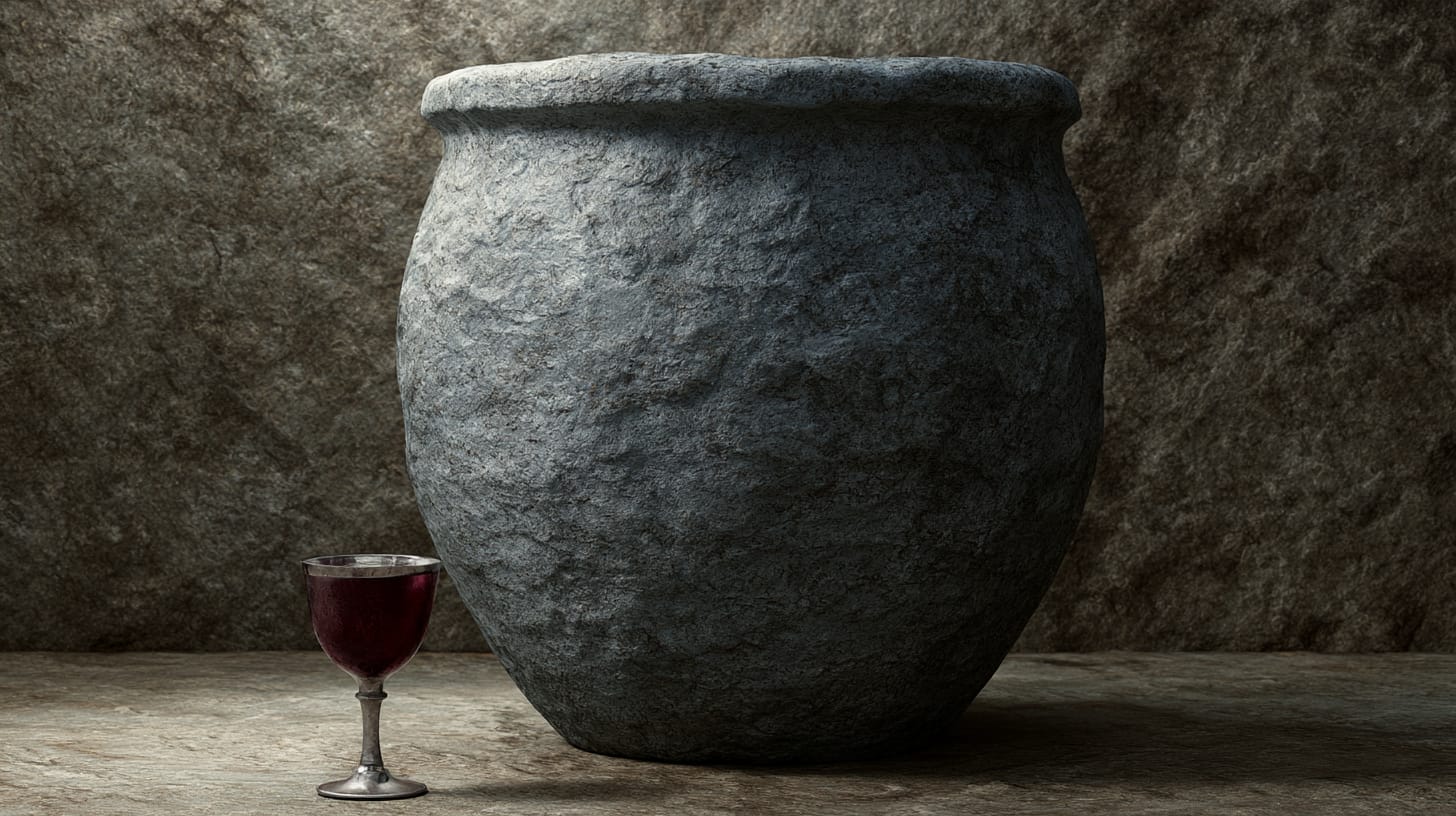
Six stoneA natural material whose substance remains what it is regardless of how it is shaped or how fine it is ground. In the biblical symbol-system, stone represents truth as it is found in reality — unmanufactured, carrying its own integrity. The altar of uncut stone, the tablets of the commandments, Christ as the foundation stone — the same substance at different scales and purposes. The everyday word is lithos — a stone that can be set, built with, or rejected (living stones, 1 Peter 2:5; the stone the builders rejected, Psalm 118:22). Petra is bedrock — the immovable foundation a house is built on (Matthew 7:24-25). Same substance, different scale. Synonyms: rock, petra, lithos, foundation, boulder, gravel. See also: Sand, Brick, Mortar More jars — “for the purifying of the Jews.” Six, the number of man. Stone, the material the lawFrom the Hebrew Torah — instruction, direction — rooted in yarah, to aim as an archer toward a target. Never primarily legislative. The stone tablets were hidden inside the ark, inside the most holy place, mediated by a priest. The promise was always to move that instruction from stone to flesh — from concealment behind a veil to working from within the person. Synonyms: Torah, nomos, instruction, teaching, commandment, mitzvah. More was written on. Standing there empty: the vessels of an old, outward cleansing. What feast is about emptying out the old?
“Fill them with water… to the brim.” Be filled — but with what? “Be filled with the Spirit” (Ephesians 5:18). And the water, drawn out, is wine. What feast is the filling?
“You have keptFrom the Hebrew shamar — to watch over, guard, protect, give attentive care to. A shepherd shamar the flock. The keeping the feasts and sabbath requires is the attentive, protective engagement that creates the conditions for seeing what they reveal — not external compliance with a schedule. Synonyms: shamar, observe, guard, watch over. More the good wine until now.” The steward tastes it and marvels — the best was saved for last. The better covenant (Hebrews 8:6) — new wine the old skins could never hold (Luke 5:37-39).
Now stand back from the walk and look at the order we just came through:
- the hour — PassoverThe LORD's Passover, kept on Nisan 14 (Lev 23:5): the lamb slain and its blood marking the houses spared in Egypt (Ex 12). The New Testament presents Christ as the Passover lamb (1 Cor 5:7), making it the opening act of the feast year. Synonyms: Pesach. See Was the Passover a Sin Offering? — at the Cross More, the cross
- the emptied stone jars of purifying — the Days of Unleavened BreadThe seven days following Passover — Nisan 15 through 21 — when leaven is put out and only unleavened bread is eaten (Lev 23:6). Scripture calls that bread the "bread of affliction," tied to leaving Egypt in haste (Deut 16:3) — a fuller sense than leaven simply standing for sin. Synonyms: Feast of Unleavened Bread, Unleavened Bread, ULB. See Does Leaven Really Mean Sin? More
- filled to the brim, water become wine — PentecostThe fiftieth day — the annual holy day (a sabbath) that closes the Feast of Weeks, the culmination of its seven-week count. In Acts 2, the day the Spirit was poured out on the gathered ekklesia. The Greek pentēkostē simply means fiftieth. Pentecost is the holy day, not the feast itself — the feast is the seven weeks it completes. The connection between Pentecost and the eternal Jubilee cycle is explored in From Fifty Days to Eternity. Synonyms: pentēkostē. More, the Spirit
- the good wine, the wedding, his glory — the marriage still to come
The little story at CanaA village in Galilee whose name echoes qaneh, a reed or measuring-rod — the setting of Jesus’ first sign, water turned to wine at a wedding (John 2:1–11), which John frames not as a bare miracle but as a sign that points past itself. A distinct name from Canaan, with which it shares only a sound. See also: An Entire Message More ran the whole calendar. Passover to Pentecost to the wedding feast — the entire framework, folded into one quiet sign at the very beginning, and pointing back to the whole of it. “The first of his signs,” indeed.
Now read it again:
On the third day there was a wedding in Cana of Galilee, and the mother of Jesus was there.— John 2:1
How do you take it now?
Further study
We just followed one such thread. There’s a name for this kind of reading — remez(Hebrew, "hint") — a detail on the surface of a text, often an oddity or apparent inconsistency, that points past itself and invites a closer look. In the traditional four levels of Hebrew reading it is the second, the "hint": the plain sense is not wrong, but it is not the whole. Synonyms: hint, allusion. See An Entire Message More, the hint in the surface that says look closer. The sign is full of them; here are a few more we left untraced. These aren’t laid out to be answered for you — that part is yours. See what they open.
- The place-names. Cana. Galilee. Look them up. Why would John bother to tell us where?
- Why six jars? And why stone, not clay? (Exodus 24:12 — what else was written on stone?)
- “According to the manner of the purifying of the Jews.” What were these jars for, before? (Hebrews 9:13-14.)
- Wine, water, stone — but no bread, and no leavenIn the biblical symbol-system, leaven is amoral — neither good nor evil in itself. It represents doctrine, teaching, knowledge, influence: the system that permeates whatever it enters and transforms it from within. The type of leaven matters; "the leaven of the Pharisees" is their doctrine, not leaven as a category. Synonyms: yeast, leavening. See Does Leaven Really Mean Sin? More anywhere. Why not?
- Twice in this gospel Jesus calls his mother “Woman” — here, and one other place. Find the other.
- “My hour is not yet come.” Trace that one word to the end of the book. (John 7:30; 8:20; 12:23; 17:1.)
- The mother — and “the Jerusalem above… the mother of us all.” (Galatians 4:26.) Why was she already there?
- The first miracle of Moses turned water to blood (Exodus 7:20). The first sign of ChristNot a surname but a title: the Greek Christos, rendering the Hebrew Mashiach (Messiah) — "the Anointed." The anointing that set apart Israel's kings, priests, and prophets all converges on the one person it was pointing to. Synonyms: Messiah, Anointed, the Anointed One, Mashiach, Christos. See also: Logos More turned water to wine. What changed between them?
- Roughly a hundred and fifty gallons of the best wine — for a party already well drunk. Why so absurdly much? (Isaiah 25:6.)
- The steward did not know where the wine came from — “but the servants who had drawn the water knew.” Why does John tell us who knew?
- Water, the master of the feast, the bridegroom — who is who?
- “This beginning of signs.” Beginning of how many? Start counting as you read on. (John 4:54.)