The Biblical Principle of Cycles Within Cycles
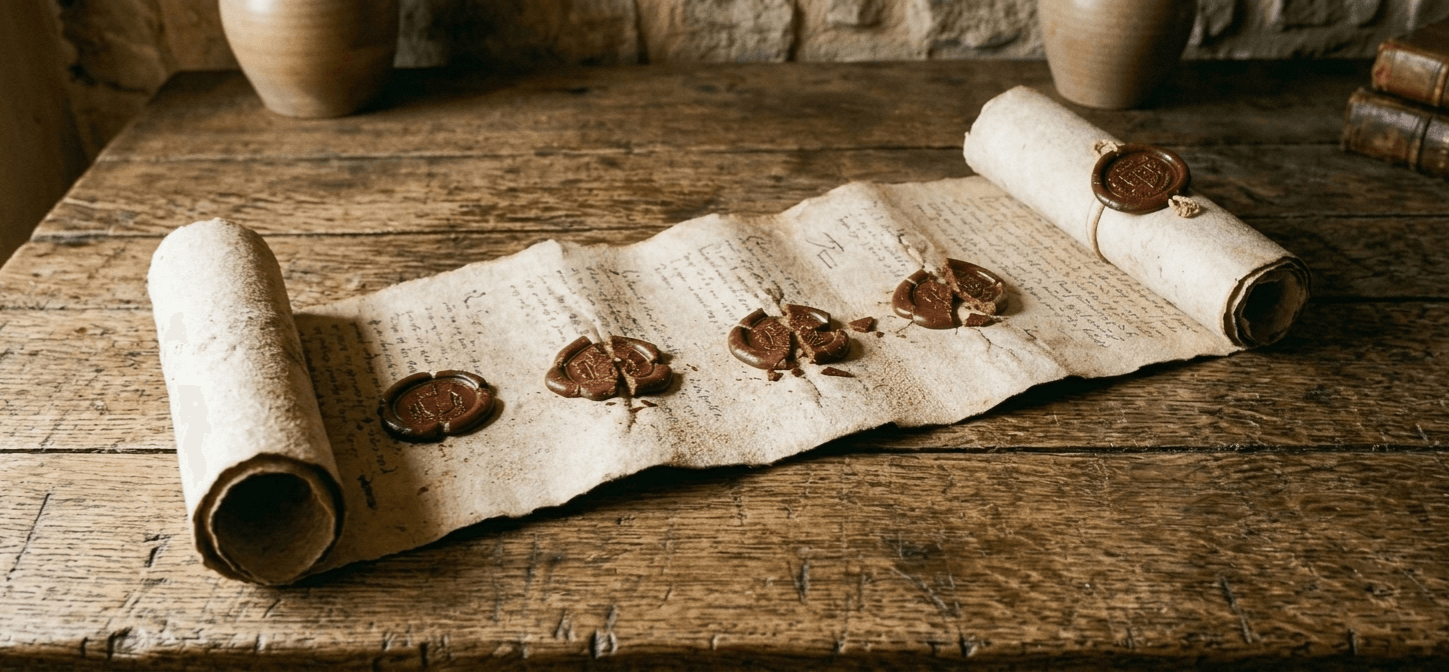
When John is handed the scroll in Revelation, it is sealed with seven seals. We tend to read past that word. A scroll is not a book. A book lets me skip to the last chapter and read how it ends. A scroll will not. It is one continuous length, rolled, and if it is sealed along the way you cannot reach the seventh seal without first breaking the six before it. You have to go through it. The order is not decoration; the order is the only way in.
So watchIn plain English, to observe means to see attentively — to give careful, focused attention to something. This is precisely what the Hebrew shamar points at: watchful, protective attention toward something valued. In religious usage, "observe" has been reduced to performing an external requirement. Synonyms: shamar, keep, watch, guard. More what happens, and for now leave the contents alone — set aside what each seal pours out. We are not looking at the trees yet. We are looking at the shape of the forest.
Six seals open, one after another. Then the seventh opens — and inside it are seven trumpets. The seventh seal does not simply end the sequence. It contains the next one. And when the seventh trumpet sounds, inside it are seven bowls. Again the last member of the cycle is not a finish line; it is a door into another full cycle of seven.
| Seal 1 | Seal 2 | Seal 3 | Seal 4 | Seal 5 | Seal 6 | Seal 7 | |||||||||||||||||||||
|
▼ The 7th Seal contains the Seven Trumpets
|
|||||||||||||||||||||||||||
Each group of seven is like a weekThe cycles of day, month, and year we observe in the heavens — the earth's rotation, the moon's orbit, the earth's circuit around the sun. The week has no such anchor in the sky, yet we are instructed to observe it too — a complete cycle of seven culminating in the seventh, the same shape that surfaces everywhere in Scripture. Synonyms: shavua, cycle of seven. See also: Sabbatical year. See Where Does the Week Come From? More — a complete cycle — though not the same. The seventh member of each cycle does not end the sequence; it opens to contain the next cycle within it.
Set your own calendar down next to that diagram. Seven days make a week, and the week is complete in itself — and then it opens into the next week, and weeks gather into something larger, and that into something larger still. The seals are like a week. The trumpets are like a week. The bowls are like a week. Not the same — similar. Learning to tell similar from same is most of the work here. What you are looking at is a pattern: groups of seven, each one whole, each one nested inside the seventh of the one above it.
That is the principle. Cycles within cycles. It is simple, and simple does not mean unimportant — it means you can carry it. Don’t take my word for how important it is; in time you will see it for yourself, and then it won’t be my word at all.
I keepFrom the Hebrew shamar — to watch over, guard, protect, give attentive care to. A shepherd shamar the flock. The keeping the feasts and sabbath requires is the attentive, protective engagement that creates the conditions for seeing what they reveal — not external compliance with a schedule. Synonyms: shamar, observe, guard, watch over. More using a phrase: the framework of the framework. Take the way God’s plan is usually laid out — a single timeline, events strung left to right, past through present into future. Now try to put the seven seals on it. You would set them in a row, the trumpets after them, the bowls after those: twenty-one events end to end. But that is not how Revelation gives them. The seventh seal does not hand off to a separate line of trumpets — it opens, and the trumpets are inside it. A single point on the timeline turns out to hold a whole cycle, and a point within that one holds another. You cannot draw that on a line. The line is not wrong; it is flattened. Set it beside the diagram and you can see what it had to leave out — levels running at once, nested and connected, one whole instead of a string of separate events.
Notice that nobody states this outright. We are not told, in so many words, “creation is built in nested sevens.” It is demonstrated — shown, laid out, repeated, until you can see it for yourself. And once you can see it you find it everywhere: in the scroll, in the feastsIn Scripture a feast — Hebrew chag — is a designated period, not a single day but a span with its own structure and sequence. The Feast of Weeks spans seven weeks; the Feast of Tabernacles, seven days. A feast may contain one or more annual holy days, but the feast itself is the full period, not any single day within it. A feast is not the same as a holy day (a sabbath), though the two connect and can coincide — the Feast of Trumpets is itself a holy day, and Atonement is both a feast and a holy day. Synonyms: festival, appointed time, moed. More, in history, in your own life. That last one is the difference between hearsay and witness. You can read a thing in a book all day; when the pattern actually runs its course in your own life, you are no longer repeating what someone told you. You have seen it.
This is one of the lessons of the Feast of WeeksThe longest feast in the Leviticus 23 calendar — seven full weeks of counting from the wave sheaf to the fiftieth day, when it is closed by the holy day of Pentecost. Beginning with the unleavened first of the firstfruits and culminating in two leavened loaves offered as firstfruits. An alternative name for this feast is demonstrated by its contents: the Feast of Leavened Bread. Synonyms: Shavuot, Feast of Firstfruits, Feast of Harvest. More. It is there in the JubileeThe fiftieth year, reached after seven sabbatical cycles of seven years and announced by a ram's-horn blast — the year when debts were released, the enslaved set free, and every family's land returned to it. It runs on the same seven-times-seven-into-fifty structure as the Feast of Weeks, on a higher scale: the pattern of seven resolving into liberty and return. Synonyms: yobel, year of release, year of liberty. See also Sabbatical year. See From Fifty Days to Eternity More cycle too — lay the two side by side and the parallels are hard to miss, along with at least one telling exception that is there for a reason. But I would rather not just tell you that. Go back to where Scripture introduces the Feast of Weeks and the Jubilee, and diagram them for yourself, the way we just diagrammed the seven seals. It may not come easily. It will be worth it. Don’t rely on me. I am pointing at something already there; the seeing has to be yours.
Then he opened their minds so they could understand the Scriptures.Luke 24:45 (NIV)
ChristNot a surname but a title: the Greek Christos, rendering the Hebrew Mashiach (Messiah) — "the Anointed." The anointing that set apart Israel's kings, priests, and prophets all converges on the one person it was pointing to. Synonyms: Messiah, Anointed, the Anointed One, Mashiach, Christos. See also: Logos More opened their minds. It happened during the Feast of Weeks, and it is bound up with this principle more tightly than it first appears. If you want to understand the Scriptures, you have to be able to see this.