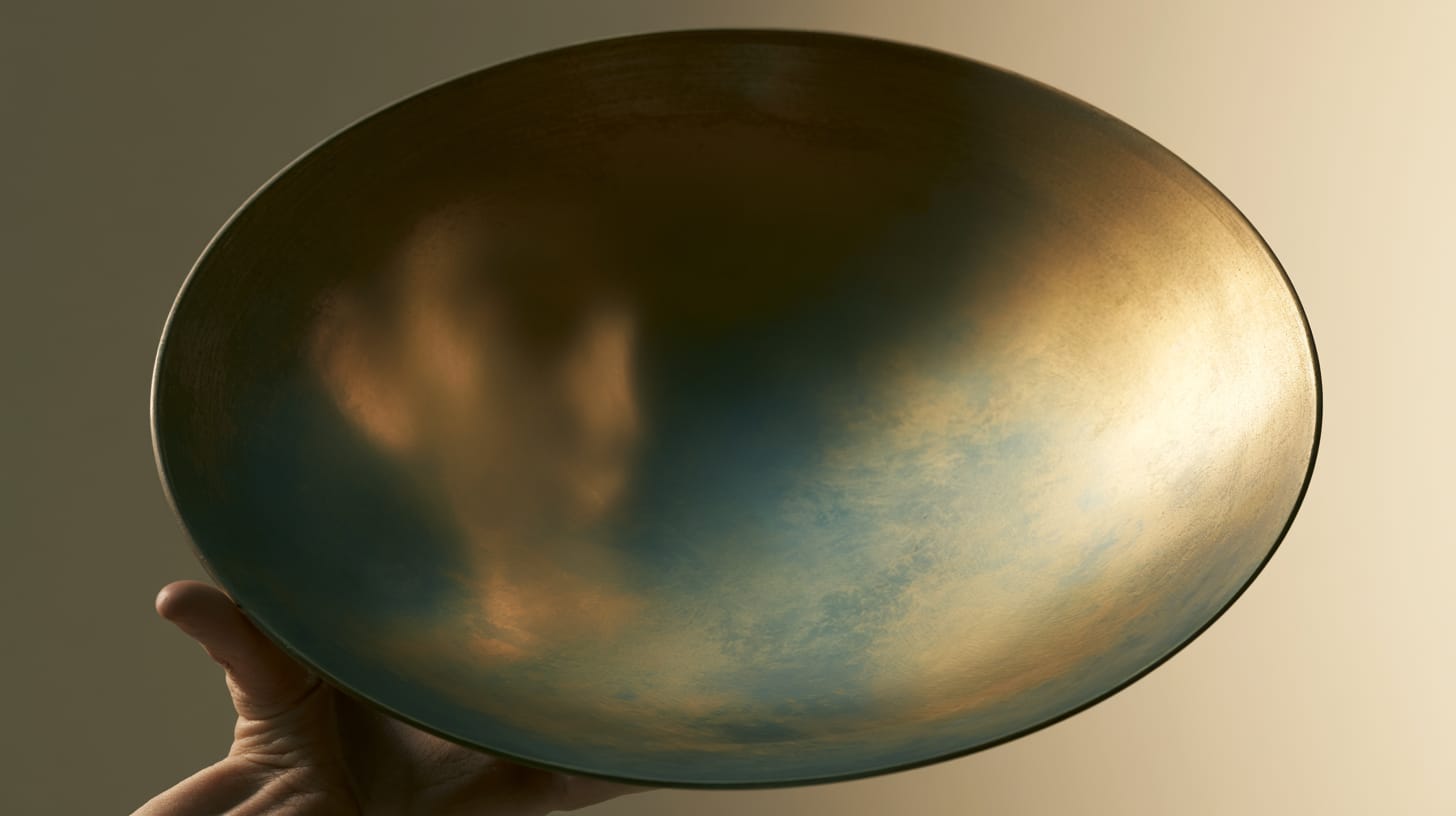
The Mask and the Mirror
In The Mask and the Metamorphosis, we watched the outer self at work as a mask-maker — metaschematizōMetaschematizō (μετασχηματίζω) — meta (change) + schēma (outward fashion). To change the outward form. Paul uses it for a real transformation (Phil 3:21) and, pointedly, for its counterfeit — false apostles who metaschematizō, masquerade, as servants of light (2 Cor 11:13-15): the mask changed, the inside untouched — the surface-work of the whitewashed tomb (Matthew 23:27). See also: The Mask and the Metamorphosis More, adjusting the surface while the interior stays untouched. But the mask deserves a second look, because it is not simply the enemy.
The outer self — the ego, the interface — is necessary. It is how we meet the world; language lives there, and everything that is seen of us. Even ChristNot a surname but a title: the Greek Christos, rendering the Hebrew Mashiach (Messiah) — "the Anointed." The anointing that set apart Israel's kings, priests, and prophets all converges on the one person it was pointing to. Synonyms: Messiah, Anointed, the Anointed One, Mashiach, Christos. See also: Logos More “was found in fashion (schēmaFrom the Greek schēma — the outward form, figure, or fashion of a thing: the surface appearance, which can be arranged or rearranged without touching what lies underneath. Scripture uses it for the temporary, presentable exterior — Christ "found in fashion (schēma) as a man" (Philippians 2:8), and "the fashion (schēma) of this world" that "passeth away" (1 Corinthians 7:31). Synonyms: outward form, fashion, figure, appearance. See also: The Mask and the Metamorphosis More) as a man” (Philippians 2:8). Scripture takes for granted an outward man and an inward man both: “though our outward man perish, yet the inward man is renewed day by day” (2 Corinthians 4:16). The interface is not the problem. The question is what we do with it — whether we use it to reveal the true self or to hide it.
That is the difference between a mask and a mirror. And underneath it lies a difference between two whole ways of standing before God: doing, and seeing. Performance, and observationIn plain English, to observe means to see attentively — to give careful, focused attention to something. This is precisely what the Hebrew shamar points at: watchful, protective attention toward something valued. In religious usage, "observe" has been reduced to performing an external requirement. Synonyms: shamar, keep, watch, guard. More.
The Word We Lost
We were told, all through the Old Testament, to observe the commandments. And somewhere along the way “observe” was quietly emptied out — from watching into performing. We now hear it as: comply, execute, do.
But that is not what the word says, and in ordinary speech we still know better. To observe the stars is to watch what is already happening — to see, to attend, to notice. We do not perform the stars.
The original words carry exactly that sense. The Hebrew shamarFrom the Hebrew shamar — to watch over, guard, protect, give attentive care to. A shepherd shamar the flock. The keeping the feasts and sabbath requires is the attentive, protective engagement that creates the conditions for seeing what they reveal — not external compliance with a schedule. Synonyms: shamar, observe, guard, watch over. More means to keep, to guard, to watch — its first appearance is Adam set to “keep” the garden, to tend and watch over it (Genesis 2:15). The Greek tēreō means to keep watch over. And our English observe is the Latin observare — ob + servare, “to watch over.” The word was always about seeing. The flattening into mere performance lost the eyes.
This is the whole difference between the mask and the mirror. Performance belongs to the mask — the surface arranged, the conduct managed, the appearance maintained. Observation belongs to the mirror — watching, beholding, seeing what is actually there. “Observe the commandments” was never a command to perform. It was a call to watch.
The Unveiled Face
Seeing requires an unveiled face. Paul sets the mirror exactly there:
When one turns to the Lord, the veil is removed. — 2 Corinthians 3:16 ESV
The turning is metanoiameta (change) + nous (mind): deeper than the English 'repentance.' A renovation of perception — the "renewing of your mind" Paul urges (Romans 12:2) — from which a real change of direction follows. See also: The Mask and the Metamorphosis. More — the mind turned. Not a remorse to be performed, but a reorientation of the mind toward what it could not see before. And with the veil gone:
And we all, with unveiled face, beholding the glory of the Lord as in a mirror, are being transformed into the same image from one degree of glory to another. — 2 Corinthians 3:18
The mask comes down; the face is unveiled; and now, for the first time, there is beholding. Metanoia is the turn from performing to seeing.
What the Mirror Shows First
With the mask down, the first thing the mirror returns is ourselves — and not the managed version. We see the surface we have kept, and the interior it covered. This honest seeing is where metanoia begins.
But there is a way to get even this wrong:
For if anyone is a hearer of the word and not a doer, he is like a man who looks intently at his natural face in a mirror. For he looks at himself and goes away and at once forgets what he was like. — James 1:23-24 ESV
The word there is logos. We can look straight at ourselves in its light and walk away unchanged — a glance, then forgetting. A seeing that does not remain changes nothing. The self-image was never the destination; it is only the first thing the glass returns.
We Are the Mirror
For Paul does not say we look into the mirror and see ourselves. He says we behold the glory of the Lord — and are changed into the same image. The Greek verb, katoptrizomai, holds both senses at once: to behold as in a mirror, and to reflect as a mirror.
Which means we are the mirror. A mirror returns whatever it faces. Turned in on the self, it returns the self. Turned — unveiled — toward the Lord, it returns Him. Moses beheld God and came away with a shining face; he had become a reflecting surface. And Paul names what we are turned toward:
God… has shone in our hearts to give the light of the knowledge of the glory of God in the face of Jesus Christ. — 2 Corinthians 4:6 ESV
This is the mechanism the first post left unspoken. MetamorphoōMetamorphoō (μεταμορφόω) — A compound Greek verb joining meta (change, beyond) and morphē (the essential, underlying nature of a thing). Where metaschematizō modifies the outward costume, metamorphoō reconstructs what’s underneath — an organic transformation of essence driven from the inside out, from which we derive the English word metamorphosis. It describes Christ’s divine nature breaking through His physical appearance at the Transfiguration (Matthew 17:2), and stands as the ultimate fruit of a mind genuinely renovated by metanoia. See also: The Mask and the Metamorphosis More does not run on effort; it runs on beholding. We are changed into what we steadily watch:
…when he appears we shall be like him, because we shall see him as he is. — 1 John 3:2 ESV
Likeness follows sight. We become what we behold — which is precisely why the mask can never reach it. Performance is something we do to ourselves; beholding is not. We cannot manufacture the new nature any more than we can command our own faces to shine. We can only unveil, and watch, and keep watching.
The Feasts, Observed
Now the lost word comes home. Christ fulfilled the feastsIn Scripture a feast — Hebrew chag — is a designated period, not a single day but a span with its own structure and sequence. The Feast of Weeks spans seven weeks; the Feast of Tabernacles, seven days. A feast may contain one or more annual holy days, but the feast itself is the full period, not any single day within it. A feast is not the same as a holy day (a sabbath), though the two connect and can coincide — the Feast of Trumpets is itself a holy day, and Atonement is both a feast and a holy day. Synonyms: festival, appointed time, moed. More — the whole Old Testament system — externally, in history: a life lived out where it could be seen, demonstrated, handled (1 John 1:1). That is the image in the external world.
And the same feasts are fulfilled internally — in us. Paul says it plainly: “that the righteousnessFrom the Greek dikaiōsis, rooted in dikaios — the Greek rendering of the Hebrew tsaddiq: right, just, in right relationship. Two senses run together: the courtroom verdict — declared righteous, acquitted, set against "condemned" (Romans 8:33-34) — and the older, wider Hebrew tsedeq: a setting-right of what was out of order, God's own righteousness as saving action (Isaiah 46:13). The word carries both; leaning on either alone narrows it. Synonyms: justify, justified, dikaiōsis, dikaios, righteousness, tsaddiq. More of the lawFrom the Hebrew Torah — instruction, direction — rooted in yarah, to aim as an archer toward a target. Never primarily legislative. The stone tablets were hidden inside the ark, inside the most holy place, mediated by a priest. The promise was always to move that instruction from stone to flesh — from concealment behind a veil to working from within the person. Synonyms: Torah, nomos, instruction, teaching, commandment, mitzvah. More might be fulfilled in us, who walk not after the flesh, but after the Spirit” (Romans 8:4). Fulfilled in us — done in us, not performed by us. Not performance. Observed. The mirror, through metanoia, lets us watch the feasts being fulfilled in our own lives — not as a calendar we execute, but as a work we recognize underway within. As the feast season is “a process to be lived” (Why Seven Feasts, but Three Seasons?), so it is a process to be watched.
This is what both sides miss in Nowhere on That Spectrum. The long argument over whether the Law is performed or set aside runs entirely on the mask side — both camps inherited observe = perform. But if observe = see, the feasts were never a code to keep or discard. They are a fulfillment to watch happening within. Recognition. Discovery. Observation.
And here the two images turn out to be one. The external Christ — his life, his fulfillment of the feasts — and the internal Christ — the same feasts fulfilled in us — are not two images but one, seen in two worlds. We were made in the image of God (Genesis 1:27); Christ is that image (Colossians 1:15); so what is formed in us is not a stranger painted over the self, but the same image restored — “Christ in you, the hope of glory” (Colossians 1:27). Beheld without; formed within; one image.
The Witness
And only now can we say the next word: witness. A witness — martys — is one who has seen. We can testify to nothing we have not observed.
That which was from the beginning, which we have heard, which we have seen with our eyes… we bear witness. — 1 John 1:1-2
Performance produces compliance — a record of things done. Observation produces a witness — someone who has actually seen, and can tell what they saw. The feasts performed leave us with a kept calendar. The feasts observed leave us with something to testify to, because we watched them come true.
Now, and Then
The mirrors of the ancient world were polished bronze — a true reflection, but dim. Paul uses it on purpose:
For now we see in a mirror dimly, but then face to face. — 1 Corinthians 13:12 ESV
The dimness is partial by design, and Scripture names the partialness: the Spirit given now is the arrabōn (2 Corinthians 1:22; 5:5; Ephesians 1:14) — the down payment, the pledge, the token laid down to guarantee the whole. The same word came to mean an engagement ring. The dim mirror is the betrothal; the face to face is the marriage. There is even a smaller pledge hidden in the feasts themselves: Christ lay three days in the tomb and “saw no corruption” (Acts 2:27) — three days unleavened, where the feast runs seven. A partial. Not yet the whole.
We do not yet hold the full sight. But we hold its pledge — and the changing has already begun in the dim glass.
The Mask or the Mirror
The mask and the mirror ask opposite things of the same face.
The mask asks us to arrange it — to perform — and nothing underneath changes.
The mirror asks only that we unveil it, and watch — not the forgetful glance, but the steady seeing that does not walk away. Everything else is done to us by what we behold.
One we maintain. The other remakes us. We cannot do both — there is only one face, and it cannot be masked and unveiled at the same time. The mask covers the very face the mirror needs bare. And only one of the two ends with a face that shines.
Which leaves the question with us. An honest silence where we haven’t seen? Hearsay repeated as if we had? Or sight of our own — and a witness we can finally bear?