What Is A New Lump? – A Demonstration
Builds on Does Leaven Really Mean Sin? — what leavenIn the biblical symbol-system, leaven is amoral — neither good nor evil in itself. It represents doctrine, teaching, knowledge, influence: the system that permeates whatever it enters and transforms it from within. The type of leaven matters; "the leaven of the Pharisees" is their doctrine, not leaven as a category. Synonyms: yeast, leavening. See Does Leaven Really Mean Sin? More stands for.
Mix flour and water into a stiff lump, add nothing else — no yeast, no starter — cover it, and set it on the counter. For a day it does almost nothing. By the second day it has swelled, shot through with bubbles, giving off a faint sour smell. You added no leaven. It leavened itself. Hold onto that, because it answers a question Paul asks that rarely gets read slowly enough:
Cleanse out the old leaven that you may be a new lumpGreek neon phurama — a fresh batch of dough (1 Corinthians 5:7). Not the old lump cleaned up but a new one entirely: the old self and its accumulated leaven put out, and a new lump able to receive the understanding Christ gives. See What Is A New Lump? — A Demonstration More, as you really are unleavened. For ChristNot a surname but a title: the Greek Christos, rendering the Hebrew Mashiach (Messiah) — "the Anointed." The anointing that set apart Israel's kings, priests, and prophets all converges on the one person it was pointing to. Synonyms: Messiah, Anointed, the Anointed One, Mashiach, Christos. See also: Logos More, our PassoverThe LORD's Passover, kept on Nisan 14 (Lev 23:5): the lamb slain and its blood marking the houses spared in Egypt (Ex 12). The New Testament presents Christ as the Passover lamb (1 Cor 5:7), making it the opening act of the feast year. Synonyms: Pesach. See Was the Passover a Sin Offering? — at the Cross More lamb, has been sacrificed. — 1 Corinthians 5:7 (ESV)
He does not say cleanse out leaven. He says the old leaven. And he says become a new lump. What is a new lump?
God has a habit of teachingFrom the Hebrew Torah — instruction, direction — rooted in yarah, to aim as an archer toward a target. Never primarily legislative. The stone tablets were hidden inside the ark, inside the most holy place, mediated by a priest. The promise was always to move that instruction from stone to flesh — from concealment behind a veil to working from within the person. Synonyms: Torah, nomos, instruction, teaching, commandment, mitzvah. More through the thing itself rather than around it — the tabernacle built to a pattern shown on the mountain (Exodus 25:40), the whole ceremonial system “a copy and shadow” of something real (Hebrews 8:5), the invisible made plain through what has been made (Romans 1:20). The parables work this way; even the miracles are parables in action, acted out. Leaven is one of these physical things. So to read Paul, the move is not to think harder about the word. It is to make bread. (See The Same Shape at Every Scale)
Years ago I lived a few streets from a bread factory. The whole neighborhood smelled of it — you couldn’t step outside without picturing warm, buttered bread. But a factory loaf is a modern thing, mixed and proofed and turned out by the thousands.
When the Bible says leaven, it means sourdoughWhen Scripture says "leaven," it means sourdough — a living culture of wild yeast and bacteria kept as a "mother" lump, not the packet yeast of modern baking. It works by permeating the whole batch and turning it to its own character — which is why leaven pictures an influence rather than a mere additive, and why Jesus' warning about the leaven of the Pharisees is glossed as "the teaching" (Matthew 16:12). See What Is Sourdough Bread? More — not a packet of yeast from the store, which the ancient world did not have. Every household kept a “mother” lump of dough that carried the yeast. To bake, you tore off a piece, kneaded it into fresh flour and water, and let it work; then you fed the mother with more flour and water to keep it alive. (See What Is Sourdough Bread?)
And where did the yeast come from in the first place? It is already everywhere — in the air, on the grain, in the flour. There is no such thing as a perfectly unleavened kitchen; leaven is in the room with you. Along with the wild yeast come bacteria, and the good ones — strains of lactobacillus — are what give sourdough its tang. That is why a brand-new mother lump can start from nothing but flour and water: the living things are already in it, and the moment there is something to eat, they wake up and begin.
So why ever start a new lump? Sometimes a neighbor’s makes better bread. Sometimes the flour gets contaminated with the wrong food, which feeds the wrong organisms and spoils the whole lump — off smell, off color, no rise. And sometimes the keeperFrom the Hebrew shamar — to watch over, guard, protect, give attentive care to. A shepherd shamar the flock. The keeping the feasts and sabbath requires is the attentive, protective engagement that creates the conditions for seeing what they reveal — not external compliance with a schedule. Synonyms: shamar, observe, guard, watch over. More gets lazy or too busy, the lump goes unfed, and it collapses: the yeast and bacteria starve, and the bad ones move in. When that happens, you do not rescue it. You start over.
So I started over — flour and water, no added yeast, pressed into a lump about half the size of my fist and set in a jar under a coffee filter so it could breathe. The first day, almost nothing: a little settling, and right at the peak a few small bubbles of carbon dioxide from microbes that came in on the flour and out of the air here in the Talladega forest.
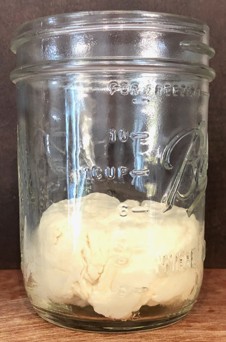
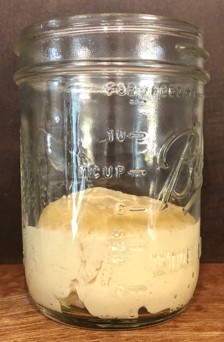
By forty-eight hours it had grown by more than half, riddled with larger bubbles — and already beginning to sag at the top, because I never fed it. Set the three side by side and the first day looks like nothing, the second like maybe, and the third is unmistakable.

Now: is that new lump unleavened, or leavened? It developed yeast — real, active leaven. But it is new yeast. It is not the old leaven. It is leavened, and it is not what came before.
Hold that next to the evening Christ rose. At an inn in Emmaus he sat with two disciples, took bread, blessed and broke it, and their eyes were opened (Luke 24:30-31). This was still the weekThe cycles of day, month, and year we observe in the heavens — the earth's rotation, the moon's orbit, the earth's circuit around the sun. The week has no such anchor in the sky, yet we are instructed to observe it too — a complete cycle of seven culminating in the seventh, the same shape that surfaces everywhere in Scripture. Synonyms: shavua, cycle of seven. See also: Sabbatical year. See Where Does the Week Come From? More of Unleavened Bread — and the word for the bread is artosGreek for bread in the generic sense — a loaf, leavened or unleavened alike. At Emmaus, Luke chose this open word for the bread the risen Christ broke (Luke 24:30), during the very week of Unleavened Bread, rather than the precise azymos he knew — but because artos names a loaf without telling its kind, it raises the question without settling it. Synonyms: loaf, bread. See also: Azymos See What Is A New Lump? — A Demonstration More, the everyday word for a loaf, not azymosGreek for unleavened bread specifically — the marked word where artos is the open one. It is the Septuagint's term for the bread of the Days of Unleavened Bread, and Luke knew it and used it elsewhere (Luke 22:1; Acts 12:3) — which is what makes his reaching for artos at Emmaus worth noticing. Synonyms: azyma, unleavened, unleavened bread. See also: Artos See What Is A New Lump? — A Demonstration More, the word for unleavened. Luke knew azymos; he uses it elsewhere when he means unleavened. Here, during the very days leavened bread is set aside, he reached for the open word instead. That does not prove the loaf was leavened — artos is general enough to cover bread of any kind. But the writer chose the unmarked word over the precise one he had on hand, which quietly leaves the burden with anyone certain it was unleavened. It is an old question and a contested one — it helped fracture the churchThe English word "church" doesn't translate the Greek ekklesia — it derives from kyriakos, a pagan term for a building belonging to a lord. Ekklesia is a called-out, gathered people; the New Testament rarely leaves it bare but qualifies it — "the church of God" (whose it is, who called it) or "the church at Corinth" (which local gathering) — never a building. The Septuagint already used it for Israel's qahal, the congregation God called out and assembled (Acts 7:38). A spiritual organism, not an institution. Synonyms: ekklesia, ecclesia, called-out ones, assembly, congregation, kyriakos, qahal, edah.
See also: firstfruits. See A People, Not a Place More once — and it comes into focus in its own place. Here it is enough to notice what the text reaches for, and to let the pattern speak.
Because leaven is not simply the enemy. There is a place where it belongs. The peace offering of thanksgiving was brought with loaves of leavened bread (Leviticus 7:13). And at the close of the Feast of WeeksThe longest feast in the Leviticus 23 calendar — seven full weeks of counting from the wave sheaf to the fiftieth day, when it is closed by the holy day of Pentecost. Beginning with the unleavened first of the firstfruits and culminating in two leavened loaves offered as firstfruits. An alternative name for this feast is demonstrated by its contents: the Feast of Leavened Bread. Synonyms: Shavuot, Feast of Firstfruits, Feast of Harvest. More, the firstfruitsFirstfruits (Greek aparchē; Hebrew bikkurim) — the first and best of a harvest, brought to God ahead of the rest and set apart as His. Scripture layers it: Christ is the wave sheaf, "the firstfruits of those who have fallen asleep" (1 Cor 15:20-23); the ekklesia are in turn called firstfruits (James 1:18) — an early portion themselves, ahead of a far larger harvest still to come. See also: Wave sheaf See Why Pentecost Has No Fixed Date More presented to God are two loaves “baked with leaven” (Leviticus 23:17) — leavened bread, offered as firstfruits. The Feast of Unleavened BreadThe seven days following Passover — Nisan 15 through 21 — when leaven is put out and only unleavened bread is eaten (Lev 23:6). Scripture calls that bread the "bread of affliction," tied to leaving Egypt in haste (Deut 16:3) — a fuller sense than leaven simply standing for sin. Synonyms: Feast of Unleavened Bread, Unleavened Bread, ULB. See Does Leaven Really Mean Sin? More and the FeastIn Scripture a feast — Hebrew chag — is a designated period, not a single day but a span with its own structure and sequence. The Feast of Weeks spans seven weeks; the Feast of Tabernacles, seven days. A feast may contain one or more annual holy days, but the feast itself is the full period, not any single day within it. A feast is not the same as a holy day (a sabbath), though the two connect and can coincide — the Feast of Trumpets is itself a holy day, and Atonement is both a feast and a holy day. Synonyms: festival, appointed time, moed. More of Weeks overlap, and the firstfruits at the far end are leavened. By its own contents, another name for the Feast of Weeks is the Feast of Leavened Bread. (See The Feast of LEAVENED Bread)
So the demonstration is doing exactly what the feast does — showing, through the thing itself, a process. The old leaven goes out: not some of it, not the parts we would choose to keep — all of it. Every settled idea about who God is, the whole inherited lump. There is no picking and choosing, because the mind that would do the choosing is the very thing being replaced. That is a death. And it is not one we manage; it is begun in us, not by us. Only then is there a new lump — able to receive the understandingIn the New Testament this is synesis — a bringing-together: scattered pieces drawn into one cohesive whole, not a quantity of information accumulated. In plain terms it is connecting the dots — understanding is unification, not accumulation. Synonyms: synesis, unification, insight, discernment See The Importance of Understanding in Jesus Christ More God gives through Christ. A new man, risen.
Leaven is knowledge — teaching, influence, a whole way of seeing — working through the lump it lives in. The question was never whether you are leavened. It is which leaven.