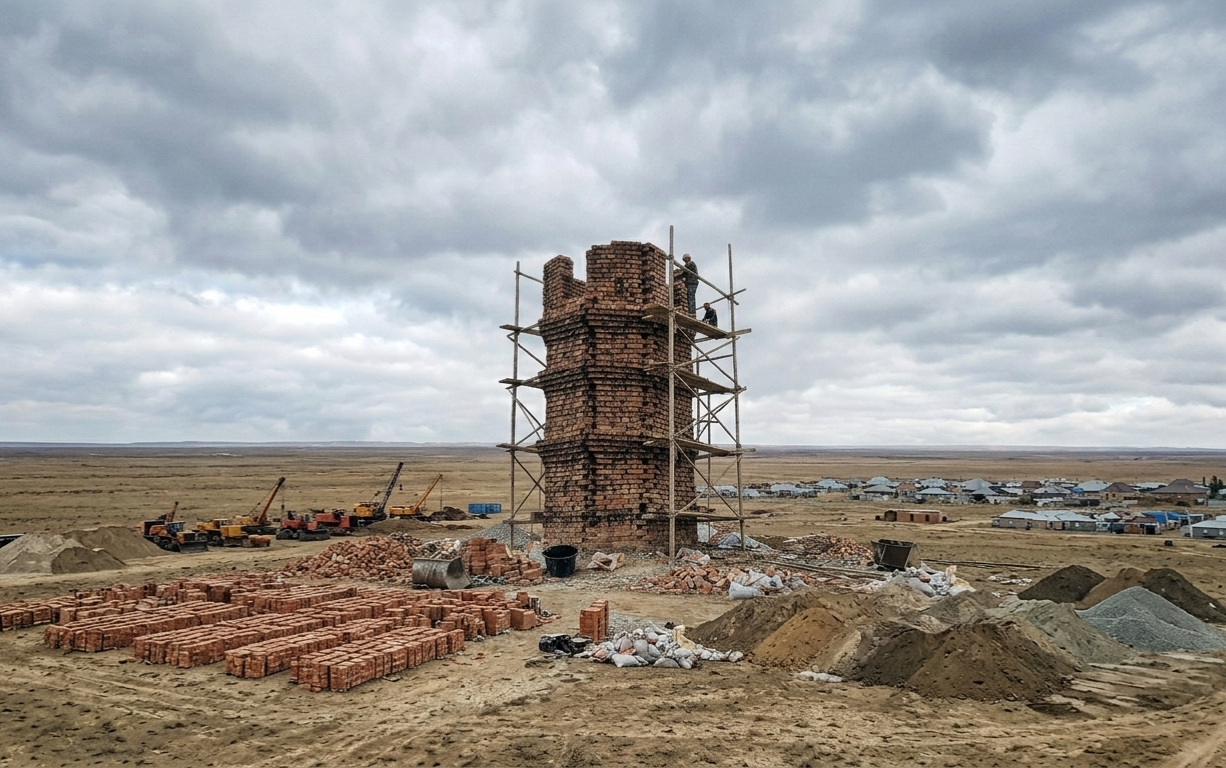
The Tower of Babel
In the beginning there was one language. One people, one speech, one shared understandingIn the New Testament this is synesis — a bringing-together: scattered pieces drawn into one cohesive whole, not a quantity of information accumulated. In plain terms it is connecting the dots — understanding is unification, not accumulation. Synonyms: synesis, unification, insight, discernment See The Importance of Understanding in Jesus Christ More.
Now the whole world had one language and a common speech. Genesis 11:1
Then came an aim:
Come, let us build ourselves a city, with a tower that reaches to the heavens, so that we may make a name for ourselves. Genesis 11:4
Two things worth noticing before the building begins. The aim is a name — reputation, visibility, the performance of ascent. The collective ego (see Mask and Verdict) reaching toward the external heaven, the visible monument, the thing that can be seen and admired. The direction is outward and upward — toward a heaven conceived as external, architectural, achievable by stacking enough material.
But what did they already have? Before the tower, before the brickA manufactured unit — clay shaped and fired into uniform, interchangeable form. Where stone is found, brick is made. In the symbol-system, brick represents fabricated reality substituted for natural reality. The builders of Babel used brick instead of stone. Synonyms: bricks, masonry. See The Tower of Babel See also: Stone, Mortar More, before the ambition — they already had something real within them. God had breathed into Adam directly. Adam had named the animals — the first act of human language in Scripture, exercised in relationship with God, from within the garden, in direct connection with the source. The tree of life was present. The pure language, in seed form, was already given. The heaven they were reaching toward, out there — had it been within them the whole time?
So Babel may be less about people reaching for what they lacked than about people turning from what they already had — building outward and upward instead of toward the heaven within, substituting an external fabrication for the reality they already possessed.
What they built with is worth a closer look:
They used brick instead of stoneA natural material whose substance remains what it is regardless of how it is shaped or how fine it is ground. In the biblical symbol-system, stone represents truth as it is found in reality — unmanufactured, carrying its own integrity. The altar of uncut stone, the tablets of the commandments, Christ as the foundation stone — the same substance at different scales and purposes. The everyday word is lithos — a stone that can be set, built with, or rejected (living stones, 1 Peter 2:5; the stone the builders rejected, Psalm 118:22). Petra is bedrock — the immovable foundation a house is built on (Matthew 7:24-25). Same substance, different scale. Synonyms: rock, petra, lithos, foundation, boulder, gravel. See also: Sand, Brick, Mortar More, and tar for mortarProduced through tremendous heat — limestone burned, transformed, then mixed. Unlike tar, which is found naturally and holds things together superficially, mortar becomes structurally integral to what it binds. In the symbol-system, mortar represents the costly work of assembling truth into cohesive understanding. Stone connected with mortar is truth assembled into knowledge that holds. Synonyms: cement, binding. See The Tower of Babel See also: Stone, Brick More. Genesis 11:3
Stone is not made. It is found — and though it may be shaped for a specific purpose, its substance remains what it is. A natural referent carrying its own integrity. Brick is manufactured — clay shaped and fired into a uniform, interchangeable unit. The material of fabrication substituted for the material of reality.
Tar is found naturally, ready to use, requiring no processing. It holds things together superficially and temporarily. Mortar is produced through tremendous heat — limestone burned, transformed, then mixed — a costly process that produces something that doesn’t merely adhere but becomes structurally integral, part of the building itself.
The builders of Babel used fabricated material held together with a shortcut. Constructing their framework from manufactured units, connected by whatever cost nothing and required no investment. No heat. No coherent integrity.
God’s response was to scatter them. Arbitrary punishment — or the surfacing of something the materials and the aim had already built in?
Come, let us go down and confuse their language so they will not understand each other. Genesis 11:7
The language fracture is the natural consequence of the improper building material and the incorrect aim. When what you are constructing with is fabricated and your connections are shortcuts, the structure cannot hold. The scattering is already inherent in the materials and in the direction.
The question Babel leaves open is not why God scattered them. It is what the reversal would require — what materials, what aim, what direction (see The Law Was Always Pointing). That question has an answer. It takes a feastIn Scripture a feast — Hebrew chag — is a designated period, not a single day but a span with its own structure and sequence. The Feast of Weeks spans seven weeks; the Feast of Tabernacles, seven days. A feast may contain one or more annual holy days, but the feast itself is the full period, not any single day within it. A feast is not the same as a holy day (a sabbath), though the two connect and can coincide — the Feast of Trumpets is itself a holy day, and Atonement is both a feast and a holy day. Synonyms: festival, appointed time, moed. More to show it. See The Feast of LEAVENED Bread.